Super Teacher Giveaway

super teacher

It’s the time of year when we need a reminder.. we teachers are super human.

Right now, I am buried in deadlines and am drowning in the very real needs of students. I figure I’m not alone in this!

Well, it just so happens that the blog prompt on #Edublogsclub for this week is to do a giveaway. Perfect timing!

So I made up this Super Teacher graphic and thought I’d use it for a giveaway. Sure, you are all welcome to just right click and save as.. but I’m talking about a real giveaway.

Like a tshirt, or a clipboard, or a poster. What do you think?

Comment on this post with what you would like for your Super Teacher item and I’ll choose a couple of people to send gifts to!

Nope, it’s not teacher appreciation week… but man, we need to be appreciated every week!

Enjoy you Super Teachers!


Winterguard, bruised knees and a powerful performance

I love watching Maddie perform. So much of our life is defined by the limitations that are put on her, that when she is able to participate in LIFE with her peers, we celebrate!

One of Maddie’s passions is colorguard/ winterguard. Participating in an event that is so hard on her body is costly to her. The exhaustion, sore muscles and constant bruising is a high price to pay, but worth it because she loves the sport.

Maddie is on Stephenville High School’s winterguard team and they have their championship competition on Saturday. On Tuesday, they were able to perform for the student body. They performed beautifully and it is always wonderful for their peers to see the amazing things that they are able to do!

Enjoy.

Are you willing to “Crucify your Baby?”

Hang around V21 and you will here…

“Are you ready to crucify your baby?”

“I’m ready to crucify my baby.”

Visitors and new students whip their heads around with a look of shock and horror on their faces. Then they turn and look at me incredulously. I just smile and say “Good!”

_______________________________________________________________

Yep, that’s how we do feedback in my art room. We acknowledge the fact that it is going to feel like someone is tearing your baby apart. And by giving it a name, we can laugh a little as we struggle to improve.

If you want to be a better artist,  you have to be willing to take hard criticism of your artwork. No one wants to find out that other people don’t like their creation.. their masterpiece! So in my art class, we have a saying for this difficult, but very necessary process. It’s called “crucifying your baby.”

New people to my world are horrified. Outsiders are uncomfortable. Students in other disciplines that find their way into my world for an extracurricular event are unnerved. But that’s okay. My students understand, and after the first encounter enjoy being part of the “club.”

Feedback with Colourful Comments Symbol

With that said, the crucifying comes with parameters, strict expectations and modeled behavior. I have learned over the years that the absolute best way to teach students how to take criticism of their work is to first require them to criticize mine!

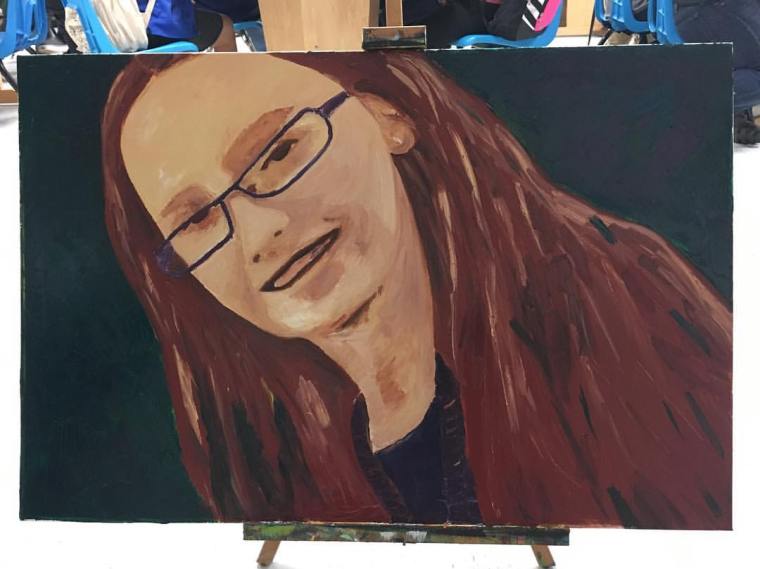
For example, this painting of my daughter Lexi has lived in my classroom as a work in progress for over a year. As I work on it in class, I use the progression and development as an opportunity to teach students to discuss and comment critically about a piece. Just from glancing at it, I see every flaw and every incomplete area. But my goal is to teach students to look for those areas and to be able to communicate their thoughts and how they would fix the problem.

14990926_10154625023930675_1736174688081904483_o

Early in the year, I start off by choosing a student to come up to my easel while the rest of the class watches. I tell the student about the piece and that I know there are problems. I point out a few areas that I don’t like that I need to fix and then I ask him/her what areas he/she saw that needed work.

My conversation starter is deliberate. In order to get students to see that I want the criticism, because I want to improve, I  have to show the student that I could see the problems and voice them as well.  By doing so, I model the example of how to state problem areas. If I get in a hurry and forgo this vulnerability with the students, then their criticism is superficial and their ability to take criticism often suffers.

In the end, while the “crucifying your baby” process sounds scary and is a memorable moment in the art room, students that want to improve get daily opportunities for feedback and quality criticism. On the flip side, students that don’t want to improve,  don’t. I used to force student to go around the room and take turns giving feedback, but I have learned that a student that doesn’t want to improve isn’t willing to take criticism and always has an excuse for why or what they did. So instead of forcing criticism, we now have a code phrase and students that are willing to embrace the opportunity thrive.

As an educator and an artist, I am always looking for ways to improve. I am always looking for ways to reach further and climb higher. I am willing to crucify my baby.

The question is, are you?

______________________________

This blog post was part of the #Edublogsclub Prompt #11 on Giving Feedback.

College Planning for Your Chronically Ill Child

Parenting is hard. Parenting a chronically ill child is even harder. Add a rare disease or two to the mix and well, it’s tough. There are so many unanswered questions, so many scary decisions that have to be made, so many what if’s. Over the years, I’ve learned a lot about parenting a chronically ill child. We have made a lot of mistakes and by the grace of God, a lot of good decisions.

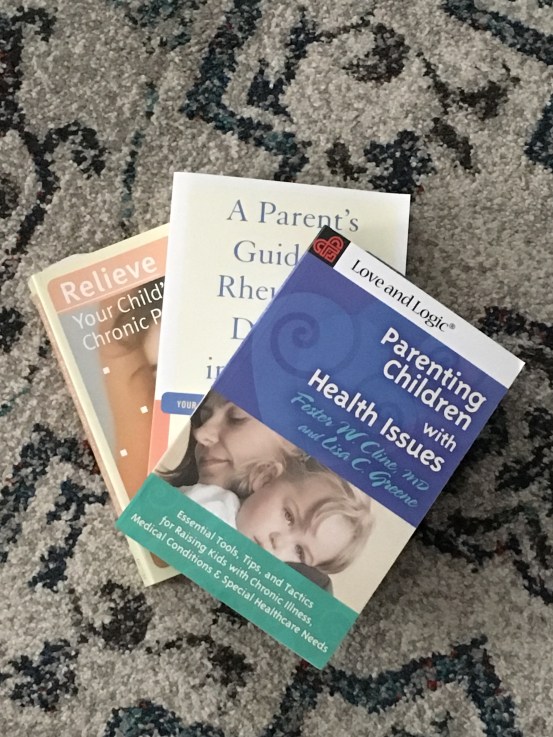
One of the best books I read very early was Love and Logic’s  Parenting Children with Health Issues. The real life stories and scenarios were parallel to our world, especially when no one around us understood our struggles, had heard of her diagnosis and couldn’t fathom our heartache.
IMG_1032

But now Maddie is a teenager, a junior in high school and we are looking at colleges. It feels like we are in unchartered territory.

Do a google search  that includes chronically ill and college planning and the results are limited at best. So, like everything else in Maddie’s life, it feels like we are once again on an island of the unknown trying to figure out what to do and where to go while we are already lost.

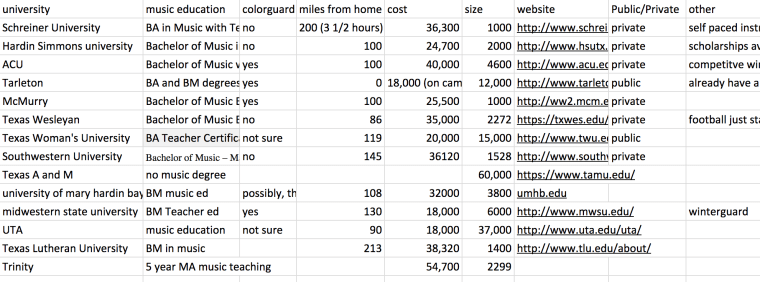
But, if the last 16 years have taught me anything, it is to research, research and research some more and keep a spreadsheet of my findings! So that’s what I did. Maddie, Doug and I have talked many times about what she wants to pursue as a career and we used her ideas as a starting point.

We came up with a set of criteria to measure the universities that we were interested in and added colleges as we found them. Besides the requirement of having a music degree, Maddie didn’t want to be too far from her doctors (or us), didn’t want a university that had a sprawling campus, she wanted small degree classes, options for her limited diet, and cost was a factor.

Below you can see a portion of the spreadsheet.
Screen Shot 2017-03-14 at 3.38.07 PM

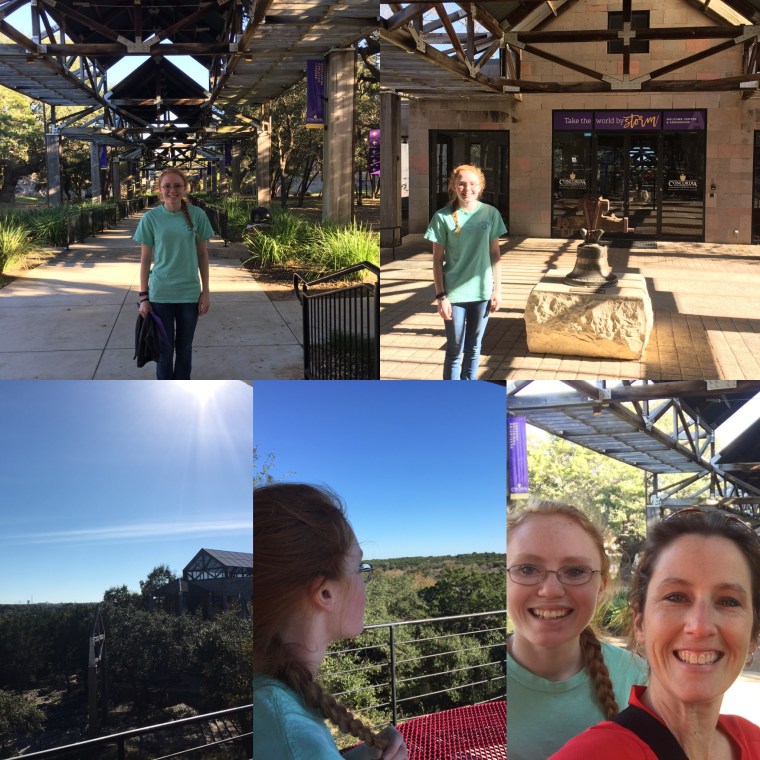
Then last fall we started visiting schools and Maddie took the ACT. People were surprised that we were already so serious about college planning, but when your child is medically fragile, you don’t have the luxury of winging things.IMG_8230

On our first round of visits, we learned that the size of the campus was going to be a crucial factor in the ultimate decision of where Maddie would go to school. One campus was sprawling, one campus a little smaller but the classes would be back and forth and back and forth in different buildings all day, and one campus was incredibly beautiful.. but tons of stairs.
IMG_8242

The ability to get around the campus easily knocked off some good contenders, but in order for Maddie to be the healthiest and most successful, she can’t put her body in a position to climb hills and stairs all day everyday.

During this time Maddie also was researching career options in music and came across Music Therapy. This was a light bulb moment for her. Music Therapy would use all of Maddie’s skills and talents AND life experiences! In choosing to narrow her career path even more, the college options changed and focused in again.

Instead of looking a dozens of universities, we were now looking at four that had music therapy degrees knowing that if none of these fit she could just major in music and get her master’s degree later.

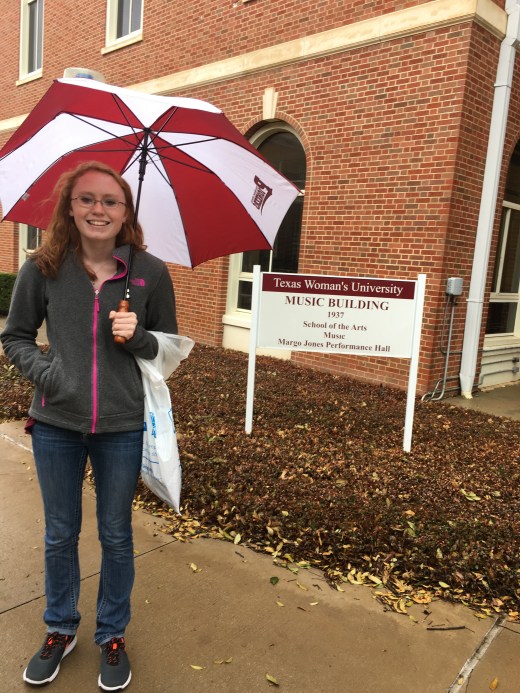
In February, we scheduled a visit and met with an admissions representative at the university that is her first choice. (Texas Woman’s University)
IMG_0117

It was a cold and rainy day, but the university felt right. Hallelujah! Everyone we met was so helpful and nice and encouraging!

IMG_0123

Will Maddie go to this university? I don’t know. I think it is a definite probable. We still have to figure out some of the logistics like the need for a private room and things like that, but based on the criteria we came up with and the good vibes we got on campus, I’m hopeful.

So what have we learned so far?

  1. Create a criteria sheet (like a rubric used in school, creating criteria keeps the emotion in check).
  2. Start early. Schedule a college visit the fall of your Junior year if not before. Maddie had spent time on two different campuses during the summer at camps, so that gave us a head start.
  3. Take the ACT and/or SAT by the fall of your Junior year. By having test scores available when talking to the admissions representatives, we were able to have initial conversations about possible scholarships.
  4. Know your class rank and class size. GPA is good too, but it is the class rank that was important for our conversations about automatic acceptance into the different universities.
  5. Go on the tour!! I’m not a big fan of scheduled tours of any kind, but the walking tours with the campus representatives have been incredibly enlightening. At one university we walked the entire campus, but we only went inside a few of the buildings. Disappointing! At another university we met the university president while on the tour. Very cool! At the third university, we got to go in the buildings where Maddie’s classes would be and random students offered to help answer questions when the tour guide didn’t know much about the music program.
  6. Establish a contact with an admissions representative. Maddie contacted the admissions rep prior to the visit with some dual credit questions. The admissions rep remembered her and was very complementary about Maddie’s initiative and willingness to work hard to be ready for college.

Finally, my most important lesson is to look at the degree program and classes NOW.

Maddie’s chosen degree has her taking 18 or 19 hours each semester of college. There is absolutely no way that her body can handle that. When we discussed this with the admissions rep, it was suggested that Maddie take ALL of her core classes outside of the normal fall/spring class cycle and were encouraged to get as much of them done via dual credit and/or community college before arriving on campus her freshman year. With this in mind, prior to scheduling Maddie’s senior year of high school, we talked classes and put together scenarios over and over.

It was weeks of work. But we were able to rearrange her course load so that she will be able to take 12 hours each semester. This means that this summer, yes, the summer between her junior and senior year of high school, she will take 9 hours at the local community college. All 3 classes will go towards her college core and 2 will be used as dual credit for high school.  She will then take another 6 hours in the fall and 6 in the spring. So essentially, we are taking a 4 year program and backing it up into high school and making it a 6 year program. Given the availability of in-person and online dual credit classes, there is no reason to wait and retake a course later.

Getting your child ready for college and making decisions about careers is hard. But unlike the tests that Maddie is facing this week that required 9 vials of blood, these decisions are pretty basic in the grand scheme of things.

One of the lessons we have learned from having a fragile child
and having to fight for her everyday
is that we know that choosing the
“wrong” university or “wrong” degree path
isn’t life and death.

If all of our research, planning and preparation end up with her at a university that isn’t a good fit,then no worries, she can transfer elsewhere.

If only she could transfer away from her rare diseases and chronic illness.

Pop Culture Mystique

Popular Culture- #Edublogsclub Prompt 9

This post is part of the #edublogsclub- a group of educators and edtech enthusiasts that blog around a common theme each week. Prompt 9 is to write a post about using popular culture in the classroom. The prompt also offered some questions that I could use to jumpstart my thinking. They were:

  • What kind of popular culture do you bring into the classroom? How do you use it?
  • Do you have any comic books or graphic novel favorites that you use for reading and textual analysis? Why do you choose those?
  • What are your favorite television shows or movies in your classes? Why do you find these helpful tools?
  • Do you have any favorite songs that you bring into your classroom? How have students responded to your music? Why do you bring in these pieces?

My initial response was rather sad. I wasn’t even sure what I was supposed to be referring to! So I did what everyone does.. I googled it.

500de98a14de7825f4ac4f1f8b4b46ab

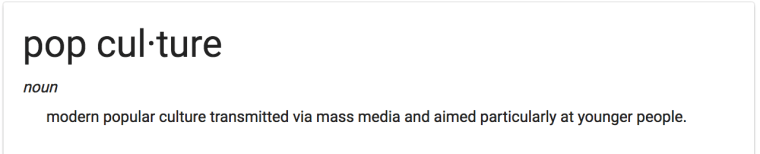
And I got:

screen-shot-2017-03-02-at-8-33-50-pm

Now armed with a good definition, I can be part of conversation. While I may not personally be conversant in the current elements of “modern popular culture that is transmitted via mass media and aimed particularly at younger people, ” I do live and work with younger people every day. More than that, I talk with younger people.

So here is what I have to say about using pop culture to reach students. Yep, I know a lot of people who are really good at that. I’m not one of them. But unlike other areas where I have lots of teacher and mom guilt, this is NOT one of those areas.

  • I don’t watch movies.
  • I watch very little television. (Big Bang Theory and Fixer Upper)
  • I read a lot, but only occasionally books that young adults read.
  • I listen to music, but again, not music that teenagers listen to.. unless they listen to broadway show tunes!
  • I facebook, instagram, use twitter occasionally and have but don’t use snapchat. But my student’s are not my friends or contacts on these social media platforms. And they shouldn’t be. Boundaries are necessary.

And you know what? I am very happy living in the land of the uncool and “out of touch.” My students are desperate for real conversations and meaningful relationships. My lack of understanding of pop culture doesn’t hinder our bond. My students don’t love me or hate me because of my relating to them about a movie or song. They love me or hate me as a direct result of my  words, actions and daily response to their real needs be it educational or emotional. I know for a fact that for some of my students, I am the only adult that listens to them. I am the only adult that talks WITH them. I am the only adult that speaks wisdom into their lives.

So, no. I’m not a cool teacher. But that’s okay. I remember having a few teachers as a teenager that were just cool. They had a beat on pop culture and could authentically talk to us and with us about the things we enjoyed. But I didn’t learn more about the subject matter because of their ability to engage with students about the latest movie. I learned the subject matter when it was taught well.

On the flip side, I also had teachers that were the very definition of uncool. My chemistry and physics teacher didn’t watch television and could not relate to students at all in terms of pop culture. But he was incredible. He knew me and what I was capable of. He pushed me to work harder and do more. He was the first math/science teacher that made me see that I was smart and could do the work.  He new his role of mentor could not be replaced and valued his work too much to focus on things that were fleeting.

In the end, I have to say that yes, there are times when I’d like to be the cool teacher or cool mom. But I’m not and if I were to suddenly use the slang that is used by students, start snapchating and talking in class about the current trends, it wouldn’t be authentic and my students (and children) would see right through the effort. So instead of trying to figure out how to fit in, I don’t. I don’t need to be. That’s not my role.
i-roll-authentic_o_580696

Declutter your house: 40Bags in 40 Days

Tomorrow is the start of Lent.

In our house we have been talking about what we are going to give up for the next 40 days. It is a hard conversation to have with a 7 year old. Kylie immediately said that she would give up soda. She doesn’t drink soda. I explained to her that really Lent is a reminder of the sacrifice that Jesus made on the cross for us, so what we give up should be a sacrifice. A small token sacrifice, but it is the mindset, not what is actually given up.

This year, I am replacing 40 of my typical meals (donuts or fast food) with super healthy meals (this is a big sacrifice for me).

I am also once again completing the 40 bags in 40 days challenge. We love using this time to declutter our house. It is amazing how much junk accumulates over the year! 40 bags is incredibly easy to fill. One year we started with grocery store bags as it seemed scary to try to fill trash bags, but we quickly realized that trash bags were the way to go. I might even use contractor bags this year!!

If you have never done a declutter challenge, start someplace easy and non-emotional. Don’t start in your closet. Start with the kitchen junk drawer. Work your way to the emotional areas like your closet and the “skinny” clothes and your child’s toy box.

I have attached my file that I use to keep track. It is a jpeg so that you can download it and print it as well.

Good luck and let me know how you did!

40-bags

Student Privacy vs Friends, Friends of Friends or Public

Student privacy is this weeks #edublogsclub prompt. Ouch and ugh and all of those step on toes feels here.

I LOVE taking pictures and sharing all of the cool and wonderful things that go on in my world both as a mom and a teacher. I took 86 pictures TODAY.. and today was a ho-hum Wednesday full of nothing special, but 86 picture worthy moments in my mind.

Here are some of the pictures from my classroom today.

Because I know that I am going to take thousands of pictures over the course of the year, I send a special release form home with the students at the start of school. While the vast majority of the pictures that I take are of hands in action, I do have clearance to take pictures of faces and video of students in action.

On my release form I also ask about posting to social media and the identification of students. While I have a couple of students each year that can’t be identified by name and face because of CPS issues and such like that, almost every parent wants the pictures of their student posted to social media so that they can share the pictures with their family and friends.

In fact, any of you readers who might be interested can watch the shenanigans from my world on:

  • Facebook at Stephenville High School Art
  • Instagram at emilymaxwellmclemore or SvilleArt
  • Twitter at artsymac or SvilleArt

If you are interested in seeing completed art projects, you can check out my student’s work at Artsonia at Stephenville High School I am very proud to say that I have published 1000 pieces of art just this school year! I can’t wait to see what we will be able to do next year when our campus goes 1:1 and the students can easily upload their own pieces!!

What is frustrating here is that Artsonia changed their user agreement this year and required parents to sign on with their email address and approve their child’s accounts. Previously, parents could sign a consent form and authorize the school to upload their child’s work without an email address.

In my world of economically disadvantaged students with a great number of non-English speaking parents, this has been a continuing problem as many parents will happily sign the consent form, but they don’t have access to go online and set up parent accounts. I expressed this frustration to Artsonia, but to no avail. Because of this, while all the parent/guardian’s approved their child’s artwork to be published online, 69 students or 418 pieces year-to-date are hidden from the public. Sad.

Nonetheless, I can say that yes, I take tons of pictures and post students in action almost on a daily basis. I understand privacy issues but sometimes get caught up in the moment. Living in the land of teens, I am usually just focused on making sure that I don’t get shots of cleavage while taking a picture of hands at work or making sure that I don’g get a clear shot of what is on their phone. While it is almost always the screen of their music.. you never know!

In the end, student privacy and social media is an ever evolving issue. In today’s world filled with constant scrutiny and fear over loss of educational dollars, using social media to promote the incredible authentic teaching and learning that is going on in public schools is crucial.  The best defense is an even better offense. I make sure that my community, district administrators and parents know that when student’s enter my classroom that their time is used wisely, that they are engaged in meaningful activities and that visitor’s are welcome.

img_0375-2


7 reasons why I love working in a public school

THE LISTICLE – #EDUBLOGSCLUB PROMPT 7
I didn’t even know what a “listicle” was when I got this week’s #edublogsclub prompt! Thankfully, they had a wiki article about them… basically its a short form of writing for the internet that uses lists.
Well, I am all in on this one. I LOVE lists!!
So here you go…

7reasons

7 reasons why I love working in a public school

  1. You are challenged every single day to work to improve the lives of all people with no regard to race, color, creed, mental ability, disability or social status.
  2. You are challenged to do more with less resources than you thought possible. (Sure, we would all love more resources, and we deserve more resources, but being able to create magic in the lives of our students with sometimes nothing is pretty amazing.)
  3. You are given the opportunity to love thousands of students in the course of your career. As a high school teacher closing in on 20 years of teaching, I’ve already taught, mentored, and can tell you personal stories about more than 3000 students.
  4. You are given the opportunity to hone your craft, adapt your teaching style and become a better mentor with every new crop of students.
  5. You are offered a chance to learn from the past and start fresh every new academic year. Yesterday’s problems and last year’s power struggle don’t have to impact tomorrow’s promise.
  6. You are offered a chance to learn new curriculum  and teach new subjects. Just because you started off your career as a reading teacher doesn’t mean that you have to finish your career as one. Trust me. I hold 8 different certifications and have taught over 20 different subjects!
  7. You are NEEDED! You are IMPORTANT! You are VALUED! The world may say otherwise, politicians may make your life harder and give you more hoops to jump through, but at the end of the day, society needs you, children depend on you, and YOU MAKE A DIFFERENCE!

In this time of educational uncertainty where every time I walk by a news source and am horrified at the state of our political system, I am reminded that at the end of the day, the education system and public schools are filling a basic need in the lives of millions of students. This need will not go away no matter what politicians do to the system. So instead of wallowing in the uncertainty, I am choosing to celebrate in the daily successes my students.

May we all in public education fill our news feeds with celebrations, successes and the triumphs of teaching a truly diverse and incredible group of public school students.


A deeper approach for better results

In January, with the start of the spring semester, I deepened my approach to teaching basic drawing skills to my art 1 students. While they were not necessarily thrilled with this decision, they quickly saw the benefits to adding the “Drawing on the Right Side of the Brain” techniques. It’s something that I have wanted to do for years, but trying to fit in such a hands on approach during the middle of contest season just never seemed to work. But this year, I decided that even though I couldn’t do all of the steps, I could at least do the basic introductory steps.

I have Betty Edwards workbook and have adapted her lessons to fit a high school classroom. Her workbook is phenomenal and I wish we had time to do the entire book. (If I had just a drawing class, this is absolutely what we would do!) I take her concepts and teach basically the first five or six lessons.
9781585421954

What is truly amazing is that these techniques, because they are visual lessons and not language dependent work for ALL students of ALL abilities. Given that my classes are made of mixed abilities from the valedictorian to the non-speaking life skills student, I truly value lessons that work for all students!

Over a couple of weeks, my students learned to see every day objects with new eyes. They learned how to use a simple transparency to transform their drawings. They learned how to break large concepts into small manageable segments. And oh man, it has changed the way my students view drawing!

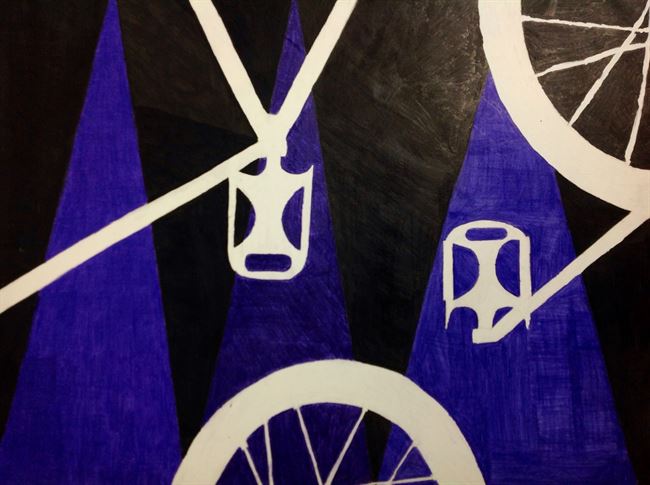
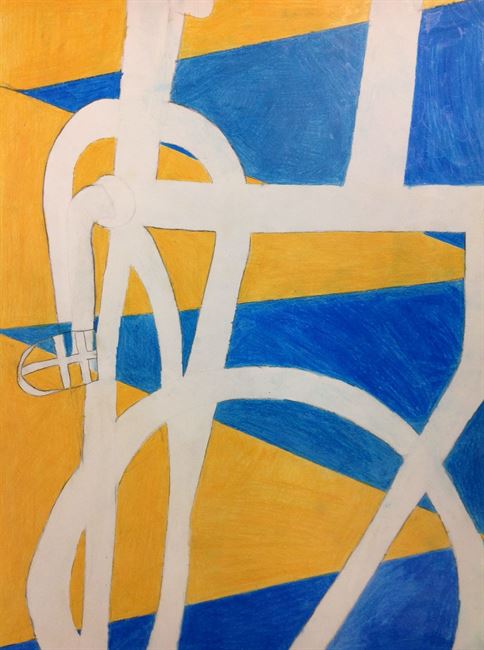
After working through basic lessons, I took a couple of my daughter’s old bicycles up to the school and set them up for the students to draw. Students then took their drawings and enlarged them onto a 18×24 piece of paper that they then had to create a positive and negative pattern on. This felt like it took forever.

But the projects are fantastic! This is the first drawing project where almost every one of my students were not only successful, but created a quality piece of art! Students that are frequent fliers in detention worked bell to bell for weeks on this piece! How I wish I could show you all 100 pieces and tell you the story of every student while you looked at their piece.

But I can’t. So I’ll show you a few really cool pieces.

So anyway, I just had to share this success story. It’s so gratifying when going that extra mile and doing that extra hard thing is rewarded. That’s a rare thing in education!

And the next time I want to set aside the lesson plans and take a few extra days to teach in a more meaningful way, I am going to remember this feeling and these results and give myself the grace to go rogue.

This slideshow requires JavaScript.

CHALLENGING SITUATIONS

CHALLENGING SITUATIONS – #EDUBLOGSCLUB PROMPT 6

This week’s #edublogsclub is about challenging situations in education. Wow. Well, as a veteran educator, I feel like I know a thing about challenges in education just from surviving this long in this profession.

I’ve been pondering education and what I consider to be the overarching challenges no matter the age or subject and these are my top 3 challenges. I found pictures from my phone to illustrate!

The greatest challenge in my opinion is knowing how much pressure to apply on students and teachers. Too little pressure and the results are lack luster. Too much pressure and the teacher and/or student folds under the weight of expectations.

I love the idea of clay on a pottery wheel as a metaphor for education. When we throw clay on a pottery wheel, it is important that the clay be wedged, have the right moisture content and be placed on the correct spot on the wheel. If any of these aren’t done correctly, the piece that is going to be thrown won’t look/work right. Further, as the wheel spins, only so much pressure can be applied to the clay at a time. Too much pressure from one side without balancing the clay in other hand will force the clay to move across the batten (base) and eventually the clay will spin off the wheel!

img_7935-2
Learning to use the right amount of pressure.

Such can be said for education! The expectations on students and teachers are spinning out of control. The increased pressure to perform better with fewer resources has caused schools to spin faster and faster and teachers and students are being slung from side to side and are holding on by a raveling thread.

Next, those that legislate education seem to forget that educators can only do so much without the proper tools. I thought this picture from my phone was perfect. A few weeks ago I need to get a cork out of a bottle, but I didn’t have a cork opener. I did a little google searching and found a you tube video that showed how to use a key to get the cork out of a bottle. I figured why not, worse case is that I ruin the cork and I can’t drink the glass of wine. So I used my house key, followed the instructions and amazingly it worked! The cork, while it didn’t look great, survived and I was able to use it to close the bottle back up.

img_9781
Not having the right tool.

This is totally the way education works! In order to get to the “prize” of good test results or  an appropriate level on the state’s accountability scale, educators are expected to figure out how to reach students without ruining the love of learning in the process and without the correct tools! The concept of “making do” is such a part of education that it’s not discussed, it just is.

And finally, my third challenge to education is that the curriculum that needs to be taught is not and can not be the priority because we are teaching children and these children deserve more than just robots that spout platitudes and absolutes.

img_9851
Understanding that what you want and need to teach is wrapped up in knots and is buried under the weight of a student’s life, the educator’s expectations and the government’s policies.

This picture from my phone is of a large mess of yarn and string tangled together. This is the very definition of teaching! Every piece of yarn represents one of my students and the pieces of yarn are tangled, knotted and completely and utterly dependent on each other to be untangled and to be given lives of their own. Sure I can pretend that the mess doesn’t exist and I can try to pull out just one piece of yarn at a time, but the reality is that in order to teach one student, I have to figure out how to teach the masses, the messes and the tangled jumble of lives. It is only when we have the yarn ball at least somewhat unraveled that we can begin to move onto teaching and learning curriculum.

So there you have it. This is where I see the challenges in education.