CHALLENGING SITUATIONS

CHALLENGING SITUATIONS – #EDUBLOGSCLUB PROMPT 6

This week’s #edublogsclub is about challenging situations in education. Wow. Well, as a veteran educator, I feel like I know a thing about challenges in education just from surviving this long in this profession.

I’ve been pondering education and what I consider to be the overarching challenges no matter the age or subject and these are my top 3 challenges. I found pictures from my phone to illustrate!

The greatest challenge in my opinion is knowing how much pressure to apply on students and teachers. Too little pressure and the results are lack luster. Too much pressure and the teacher and/or student folds under the weight of expectations.

I love the idea of clay on a pottery wheel as a metaphor for education. When we throw clay on a pottery wheel, it is important that the clay be wedged, have the right moisture content and be placed on the correct spot on the wheel. If any of these aren’t done correctly, the piece that is going to be thrown won’t look/work right. Further, as the wheel spins, only so much pressure can be applied to the clay at a time. Too much pressure from one side without balancing the clay in other hand will force the clay to move across the batten (base) and eventually the clay will spin off the wheel!

img_7935-2
Learning to use the right amount of pressure.

Such can be said for education! The expectations on students and teachers are spinning out of control. The increased pressure to perform better with fewer resources has caused schools to spin faster and faster and teachers and students are being slung from side to side and are holding on by a raveling thread.

Next, those that legislate education seem to forget that educators can only do so much without the proper tools. I thought this picture from my phone was perfect. A few weeks ago I need to get a cork out of a bottle, but I didn’t have a cork opener. I did a little google searching and found a you tube video that showed how to use a key to get the cork out of a bottle. I figured why not, worse case is that I ruin the cork and I can’t drink the glass of wine. So I used my house key, followed the instructions and amazingly it worked! The cork, while it didn’t look great, survived and I was able to use it to close the bottle back up.

img_9781
Not having the right tool.

This is totally the way education works! In order to get to the “prize” of good test results or  an appropriate level on the state’s accountability scale, educators are expected to figure out how to reach students without ruining the love of learning in the process and without the correct tools! The concept of “making do” is such a part of education that it’s not discussed, it just is.

And finally, my third challenge to education is that the curriculum that needs to be taught is not and can not be the priority because we are teaching children and these children deserve more than just robots that spout platitudes and absolutes.

img_9851
Understanding that what you want and need to teach is wrapped up in knots and is buried under the weight of a student’s life, the educator’s expectations and the government’s policies.

This picture from my phone is of a large mess of yarn and string tangled together. This is the very definition of teaching! Every piece of yarn represents one of my students and the pieces of yarn are tangled, knotted and completely and utterly dependent on each other to be untangled and to be given lives of their own. Sure I can pretend that the mess doesn’t exist and I can try to pull out just one piece of yarn at a time, but the reality is that in order to teach one student, I have to figure out how to teach the masses, the messes and the tangled jumble of lives. It is only when we have the yarn ball at least somewhat unraveled that we can begin to move onto teaching and learning curriculum.

So there you have it. This is where I see the challenges in education.


The Value of Pictures

This week’s #EdublogsClub prompt was to add photos to posts. Well, I’ve got that one down. I am constantly taking pictures and videos. My life is well documented. In fact, I have to say that I am rather proud of the fact timg_9832hat while there are 7,802 pictures in my phone, many of those pictures include fun family moments, cool projects that my students are working on and simple everyday selfies. And these photos haven’t been taken and left to die in my phone. They live again on instagram, twitter, this blog, Artsonia and facebook!

As an educator, I have learned the value of a picture taken of a student at work in my environment. A picture can express hope, frustration, encouragement, success, failure and so much more. I use pictures to show what my students are working on, what they are struggling through and eventually their successes. It keeps students accountable as I post updates on my high school art facebook page regularly and no student wants basically the same photo uploaded day after day!

Further, parents really enjoy looking into the world that their children spend so much time in. There are no secrets in my classroom and I really work hard to get authentic moments. Yes, I often end up telling kids to move their phones out of the shot.. not because I want to hide the fact that they are listening to music from their phones, but their phones are not the story of the picture and I’m afraid some naysayers about education and teens would see the phones and not see the kids hard at work!

Below are pictures taken on Tuesday from my classroom during one of my art 2 classes. It only takes a couple of minutes to take pictures and post to my school facebook page, but the goodwill from student’s families and friends is incredible!


So there you have it. I truly love taking photos of students at work and of their finished projects. It clutters my phone and overwhelms my storage space at times, but it is worth it. Besides having photo evidence of what is happening in my world, it also is a really important level of transparency in this day and age. While I don’t take pictures of every student everyday, the body of photos show the life, camaraderie and work ethic of my students and the once hidden high school art room is captured, shared and enjoyed by students, parents and the community as a whole.

Redefining Leadership

leadership-1v5d5d9-1080x674

This week’s #EdublogsClub prompt was a sticky-tricky tar baby one for sure!  Here is the prompt…

Write a post that discusses leadership, peer coaching, and/or effecting change. Here are some sentence starters that may help you as a work on the ideas for your post:

  • The best school leader I have ever worked for/with…
  • Teaching leadership skills to students…
  • The qualities of a true leader include…
  • Leaders don’t…
  • Leaders never…
  • Leaders always…
  • I wish my school administrator/boss…
  • As a leader, I wish to improve on…
  • A leader I admire…
  • Peer coaching…
  • Effecting change…

I pondered what to write about. I have so many thoughts about school leadership! Dang, I’ve been a public school teacher since 1997. I’ve taught in 2 states, in 7 school districts and worked for almost 20 principals. I’ve seen and learned A LOT about leadership! But I also want to continue working in public education and want a job as a campus administrator, so I’m not looking to air out our dirty laundry for all to see!

And then, in my course work I came across a Ted Talk by Drew Dudley and it was a light bulb (or lollipop) moment. If you have 6 minutes, it is definately worth watching!

Here are my takeaways from his talk.  Dudley states “We’ve made leadership something bigger than us, something beyond us. We’ve made it about changing the world.” Further he says that our mindset is that until we do something big enough to deserve the title, we devalue the things that we CAN do everyday.

And finally, Dudley says that sometimes the most important moments, where we are true leaders, where we impact a person’s life, where we change the trajectory of someone’s future are simply moments that are forgotten to us. We move on not even realizing that we made an impact.

So instead of focusing on the things that I wish my leaders did, or the things that I wish my leadership wouldn’t do, I’m redefining my interpretation of leadership. Yes, I want leaders to do big things that will change the world. But more than that, I want leaders (and I am including myself and my fellow teachers) to be leaders that change individual moments in the lives of our students. I want to celebrate so many “lollipop” or forgotten moments each week that everyone starts seeing themselves as leaders. I want to celebrate so many seemingly insignificant moments that impact the lives of students and their families that the students see their own leadership potential.

Because THAT is how we Redefine Leadership.

My Working Space

Welcome to my Week 2, #edublogsclub post.

The prompt asks me to share about where I get my work done, how my space is organized and any tips or tricks that I want to share.

To begin,  while I spend more hours in V-21 than anywhere else, I don’t know that I really get all that much work done.. at least between the hours of 7:45am and 3:40pm. I typically work on my graduate classes or projects for myself after hours at home. But for this post, I am going to focus on my classroom.

The Physical Space

Here is a glimpse of my classroom on the first day of school. After almost twenty years teaching, I still love the clean and organized room at the beginning of each year. It’s kind of like the “new car smell.”

img_6794

As reflected in the pictures, I have a lot of space. Good thing… I have a lot of students and two class periods a day I teach Art 2, Art 3 and AP Art and have students in both the front and back classrooms at the same time.

And then there is the real life part of this post…

This is what my corner of the room looks like today…. img_9545-2

Yes, it is cluttered! Yes, it is visual chaos.

I do my absolute best to keep the space organized, but it really gets tough. One of my best teaching qualities is my commitment to differentiation for all 120+ students. The downside is that giving personalized instruction and projects to every student who comes into my room takes lots of materials, time and space!

The aesthetics

A few years ago while taking graduate arts education courses, I learned about the Reggio Emilia approach to classroom management, education and space planning. While I still have way more useless stuff on my bookshelves than I’d like, I really took the mindset of environment as the third teacher to heart. The research discussed in the Reggio Emilia Inspired classroom resonated with me and pushed me to activate ways for students to use the “hundred languages of children” which included sculpture, painting, drawing, touch, texture and so forth.

Further, in bringing this philosophy into my classroom, I was challenged to discard the primary colored plastic tubs of the typical American classroom. Why do we find it necessary to hide supplies from students? So I stopped. One of the biggest changes was the way I stored my colored pencils.  It was a small thing in the scope of a large classroom, but it has been great!

The back story on this was that our tennis coach asked me one year if I had any need for the plastic tubes that tennis balls come in. I said yes not really knowing what I would use them for. Well, the tubes are PERFECT for colored pencils! The clear containers were exactly what Reggio Emilia called for! And because they look cool and are organized, there wasn’t a need to hide them in a closet. Even better!

img_9554

Tips and Tricks

An efficient classroom is not only one that is organized, but one that makes sense. I have been in classrooms where there were exact procedures for folders, late work and so forth, but these procedures didn’t make sense or were not consistently enforced by the teacher.

So my biggest tip for life in education is to create procedures that you are not only willing, but capable of enforcing and carrying out EVERY. SINGLE. DAY.  If you can’t commit to the procedure, then don’t bother.

For example, my students know that when it is getting close to the end of class, they had better have their space clean, supplies put away and be seated, or they won’t be dismissed when the bell rings. No one leaves the room if anyone is standing. Done. And even then, I have to say it almost on a daily basis. I don’t say it ugly, but I have to say.. “Where are you supposed to be?” or “If you plan on leaving when the bell rings, you need to be seated.” or any of the many variations on the same theme.  It’s a boundary. The teenagers in my room know that it is there, they expect it to be enforced, but they are going to check.. every single day. That’s the job of a teenager.

And you know what? Because I enforce such a seemingly insignificant procedure, I don’t have many problems in my classroom. Why? because my student’s know that the rules are the rules and I will follow through. I don’t have many rules. I don’t have arbitrary or crazy ones. I have simple, easy to enforce meaningful rules.

So that is my biggest tip and trick for classroom organization and management. Keep it simple..and keep it going. Every single day.

Man, I had so much more to say, but my soapbox is only so big, so I’ll step off it now and save my other organization tips for another post.

Final take away

At the end of the day, whether you work in a classroom, in an office, at your kitchen table, or from your bed, create for yourself a space that is inviting and a place that works for you. Sure, we all want to say that we want it to be more  organized.. but do we? Sometimes somewhat organized or loosy goosey is what resonates with our personalities and I don’t feel like apologizing for my stacks of project piles on the corner of my desk. Neither should you.

So thanks for stopping by and I hope enjoyed a glimpse into my world.

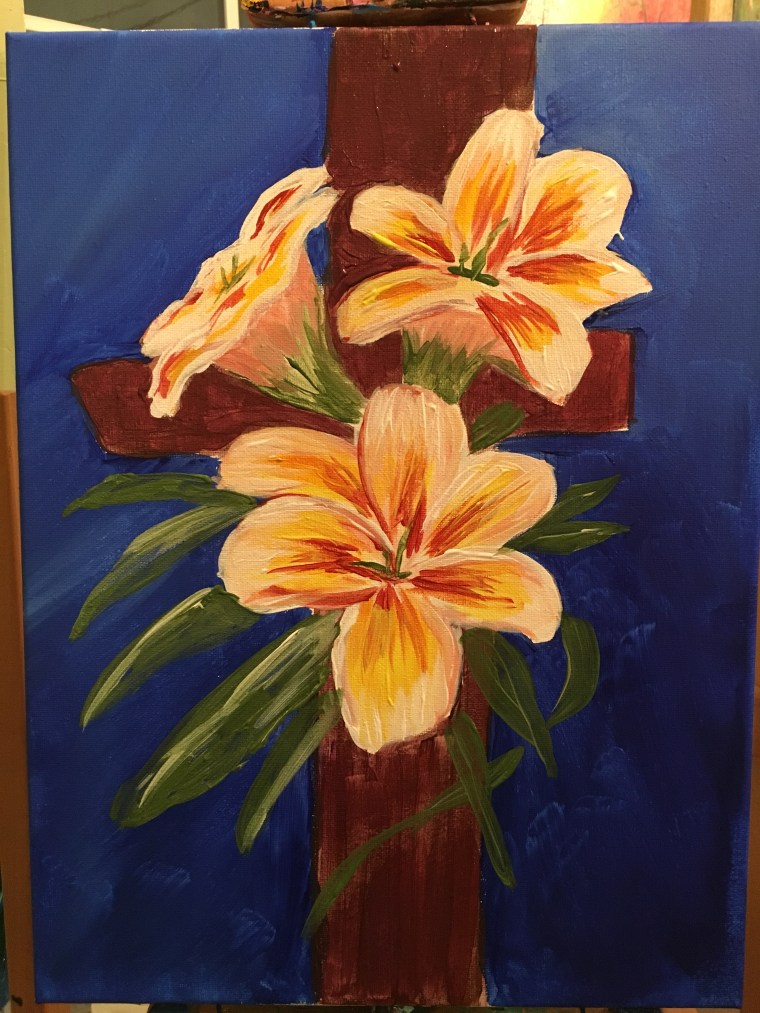
Art and Soul Painting Class

Over the last few years I have taught a few painting classes for friends. I try to keep it simple, but sometimes I have to do something a little more challenging just to keep me interested.

I taught this class right before Easter this year and really enjoyed the teaching process as it is a totally different process and mindset than what I use in the art classroom. In my classroom, good enough isn’t allowed. For a 2 hour painting class for the masses, good enough is the mantra!

IMG_8309

So anyway, just incase you were wondering if I am still painting and teaching. yep.

Not much personal painting going on as we are remodeling our house and I lost my designated painting space, but still lots of art happening in my world.