CHALLENGING SITUATIONS

CHALLENGING SITUATIONS – #EDUBLOGSCLUB PROMPT 6

This week’s #edublogsclub is about challenging situations in education. Wow. Well, as a veteran educator, I feel like I know a thing about challenges in education just from surviving this long in this profession.

I’ve been pondering education and what I consider to be the overarching challenges no matter the age or subject and these are my top 3 challenges. I found pictures from my phone to illustrate!

The greatest challenge in my opinion is knowing how much pressure to apply on students and teachers. Too little pressure and the results are lack luster. Too much pressure and the teacher and/or student folds under the weight of expectations.

I love the idea of clay on a pottery wheel as a metaphor for education. When we throw clay on a pottery wheel, it is important that the clay be wedged, have the right moisture content and be placed on the correct spot on the wheel. If any of these aren’t done correctly, the piece that is going to be thrown won’t look/work right. Further, as the wheel spins, only so much pressure can be applied to the clay at a time. Too much pressure from one side without balancing the clay in other hand will force the clay to move across the batten (base) and eventually the clay will spin off the wheel!

img_7935-2
Learning to use the right amount of pressure.

Such can be said for education! The expectations on students and teachers are spinning out of control. The increased pressure to perform better with fewer resources has caused schools to spin faster and faster and teachers and students are being slung from side to side and are holding on by a raveling thread.

Next, those that legislate education seem to forget that educators can only do so much without the proper tools. I thought this picture from my phone was perfect. A few weeks ago I need to get a cork out of a bottle, but I didn’t have a cork opener. I did a little google searching and found a you tube video that showed how to use a key to get the cork out of a bottle. I figured why not, worse case is that I ruin the cork and I can’t drink the glass of wine. So I used my house key, followed the instructions and amazingly it worked! The cork, while it didn’t look great, survived and I was able to use it to close the bottle back up.

img_9781
Not having the right tool.

This is totally the way education works! In order to get to the “prize” of good test results or  an appropriate level on the state’s accountability scale, educators are expected to figure out how to reach students without ruining the love of learning in the process and without the correct tools! The concept of “making do” is such a part of education that it’s not discussed, it just is.

And finally, my third challenge to education is that the curriculum that needs to be taught is not and can not be the priority because we are teaching children and these children deserve more than just robots that spout platitudes and absolutes.

img_9851
Understanding that what you want and need to teach is wrapped up in knots and is buried under the weight of a student’s life, the educator’s expectations and the government’s policies.

This picture from my phone is of a large mess of yarn and string tangled together. This is the very definition of teaching! Every piece of yarn represents one of my students and the pieces of yarn are tangled, knotted and completely and utterly dependent on each other to be untangled and to be given lives of their own. Sure I can pretend that the mess doesn’t exist and I can try to pull out just one piece of yarn at a time, but the reality is that in order to teach one student, I have to figure out how to teach the masses, the messes and the tangled jumble of lives. It is only when we have the yarn ball at least somewhat unraveled that we can begin to move onto teaching and learning curriculum.

So there you have it. This is where I see the challenges in education.
 

Google and the difference it makes in Education

FREE WEB TOOLS – #EDUBLOGSCLUB PROMPT 5

The world of communicating with students has changed. While some might bemoan the technology takeover, I for one, am a hardcore believer in the benefits of real-time appropriate communication with students that is made possible because of technology.

For example, last night from my own home:

  • I communicated with a student about a project and the deadlines that are looming for contest. It didn’t matter that it was after 10pm. The student sent me an email and I was able to respond and give the encouragement to finish the project.
  • I proofed a student’s work and sent feedback to the student using the comments section on Google Slides. Changes that were made were seen immediately and I could clarify where needed.
  • I read an article for my own classwork. I took notes and used a highlighter…all in a virtual format. No printing required!
  • I posted to a discussion board about education.

All of these things were time sensitive and so much easier because of the technology tools available.

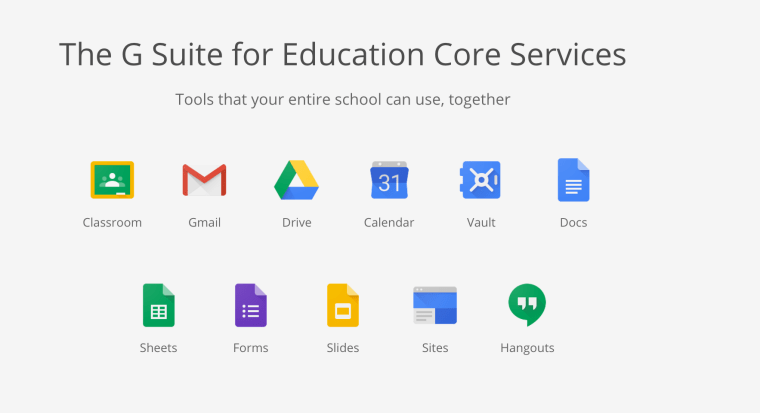
One of the best and most useful platforms that I have found to use with students is Google’s FREE Productivity Tools. The school district I work in is a Google for Education school and we use the G Suite for Education services. But I also use these services for my personal work, blog and other needs.

screen-shot-2017-02-02-at-8-06-22-am

If you haven’t started using Google Productivity Tools, I highly suggest trying them out. These tools truly change the game. How? For one, every change, edit and fix is automatically saved when using Docs, Sheets, Forms, Slides and Sites! These tools have replaced my need to use Microsoft Office tools and even better, because they are cloud based, it doesn’t matter where I want to work on files created within these programs, they are available if I have the internet.

The tools also work from a phone or tablet. Google Drive is where I store just about everything these days. I also use Google Photos to store my pictures. I can upload my photos from my phone and then delete them to free up my phone storage. I can then access the pictures from anywhere, send them to print, add them to blog posts, whatever I need. Even better, file size doesn’t matter as the storage is unlimited with the Google for Education service. I use this with my personal gmail account as well and I have 15GB free.

Lastly, if you are a teacher and expect students to collaborate on projects, using a Google product lets you really see what students did. Instead of getting a finished project that only 1 student worked on out of a group of 4, but you don’t really know what was done and when, so you have to give everyone the same grade.. now you can give a grade based on actual work provided by students! You can even have the file tell you the percentage of authorship of the file. It is really quite cool.

I could go on as there are so many more amazing Google tools, but for now, I’ll leave it at… just try them! They are free and they just might make your life easier.

The Value of Pictures

This week’s #EdublogsClub prompt was to add photos to posts. Well, I’ve got that one down. I am constantly taking pictures and videos. My life is well documented. In fact, I have to say that I am rather proud of the fact timg_9832hat while there are 7,802 pictures in my phone, many of those pictures include fun family moments, cool projects that my students are working on and simple everyday selfies. And these photos haven’t been taken and left to die in my phone. They live again on instagram, twitter, this blog, Artsonia and facebook!

As an educator, I have learned the value of a picture taken of a student at work in my environment. A picture can express hope, frustration, encouragement, success, failure and so much more. I use pictures to show what my students are working on, what they are struggling through and eventually their successes. It keeps students accountable as I post updates on my high school art facebook page regularly and no student wants basically the same photo uploaded day after day!

Further, parents really enjoy looking into the world that their children spend so much time in. There are no secrets in my classroom and I really work hard to get authentic moments. Yes, I often end up telling kids to move their phones out of the shot.. not because I want to hide the fact that they are listening to music from their phones, but their phones are not the story of the picture and I’m afraid some naysayers about education and teens would see the phones and not see the kids hard at work!

Below are pictures taken on Tuesday from my classroom during one of my art 2 classes. It only takes a couple of minutes to take pictures and post to my school facebook page, but the goodwill from student’s families and friends is incredible!


So there you have it. I truly love taking photos of students at work and of their finished projects. It clutters my phone and overwhelms my storage space at times, but it is worth it. Besides having photo evidence of what is happening in my world, it also is a really important level of transparency in this day and age. While I don’t take pictures of every student everyday, the body of photos show the life, camaraderie and work ethic of my students and the once hidden high school art room is captured, shared and enjoyed by students, parents and the community as a whole.

The parallels of long distance running and public education

I’m writing this from the comfort of my recliner. My sore and blistered feet are propped up and I’m eating all the carbs in sight. Why? I ran a 1/2 marathon yesterday, so today I feel entitled to calories and rest.

I’m not a new runner and the 1/2 marathon (13.1 miles) distance is one that I typically enjoy and am trained to complete. Yesterday’s race I made “rookie” type mistake and wore shoes that I knew going in I shouldn’t wear, but I did anyway. I paid for it.

By mile 3 my feet hurt. By mile 6 every left step was uncomfortable. By mile 11 the hot spots on the side of my right foot were killing me. But I kept going. I considered stopping and checking on my left foot, but I didn’t want to see the wound that I knew was there. So I just endured it and finished the race.

And while contemplating my stupid shoe issue, I came to realization that much like the problems with my shoes, so are the problems in education.

How? Well here are my parallels.

  1. These shoes are not a new shoe for me. I’ve worn this brand for years. But this pair is newer and they have never felt right. While the brand and the style didn’t change, something about the way they were made was changed.

    Isn’t this the way of high stakes testing? We have been testing in public education for years and years. I’m not even saying that testing is bad. We need markers so that we know what learning is taking place. But the way the tests are made has changed. The purpose and the mindset has changed even though the official reasons for testing are still said to be to measure student success.

    And because the shoe still looks like the shoe we know, we expect to be able to wear it the same with the same result.. and we end up with a bloody toe. And the test while it has changed its name over the years, still is supposed to measure student success, so we and teach the students the way we know how, expecting the same results… and we end up with disenfranchised and unsuccessful students. 

  2.  The shoes never fit right, but I wore them anyway.

    From the first time I wore the shoes, the tops of my toes rubbed in them. For short runs, my toes would be a little pink when I finished running, but it wasn’t too bad. For longer runs, I’d make sure that I wore thin socks.  I knew there were issues. But I continued to wear them. My older, comfortable shoes were past their mile markers and not suited to long runs anymore. And of course, I had just gotten these shoes. They were clean and pretty! They just had to get better!

    And so goes education. After almost 20 years in public education, I can say honestly that some of the things that we do are just plain stupid. The newest and best things for engagement, to boost test scores, to prevent drop out.. and on and on.. some of these things do work. (This post isn’t about those things…. ) And some of them never fit right, they rub students and teachers the wrong way, have continued issues and are just bad. But we do them anyway, because it is the new thing..it’s shiny and clean and pretty.. and surely, once we get used to it, it will get better! 

  3. I knew that the problem existed, but I ignored it.

    For months I wore my “pink ghosts” knowing that they didn’t fit right. But I ignored the problem hoping that eventually the issues would work themselves out. Every time I put them on, I knew the possible blisters. I would rationalize the issues and go on with my run.  My toes would hurt after a few miles, but oh well. I’d tell myself to get out that other pair of shoes from my closet and try a different pair. Good intentions and really pretty easy to take care of. But after my workout, I’d be in a hurry and quickly be off to work and not think about the shoe issue until I was about mile 3 into a run. I know, it doesn’t make sense.. but not much makes sense a 4:30am! 🙂

    And the same goes for education! Oh my does it! We know that problems exist and we even know how to fix many of them. But we act as if we ignore the problems that they will eventually either get fixed, graduate or go work someplace else! This mindset helps no one, nor does it make sense.

Running and public education are my passions.

As I strive to be a better runner, I have to be willing to stop and make necessary changes… often ones that only can be seen after the first 6 miles… including trying a new brand or style of shoes.

As I strive to be a better advocate for public education, I have to be willing to stop and make necessary changes.. often ones that can only be seen from inside the school building. For now, I focus on my classroom… but one day in the not so distant future a campus? I can hope. Until then, I will remember that this is a marathon.

My Working Space

Welcome to my Week 2, #edublogsclub post.

The prompt asks me to share about where I get my work done, how my space is organized and any tips or tricks that I want to share.

To begin,  while I spend more hours in V-21 than anywhere else, I don’t know that I really get all that much work done.. at least between the hours of 7:45am and 3:40pm. I typically work on my graduate classes or projects for myself after hours at home. But for this post, I am going to focus on my classroom.

The Physical Space

Here is a glimpse of my classroom on the first day of school. After almost twenty years teaching, I still love the clean and organized room at the beginning of each year. It’s kind of like the “new car smell.”

img_6794

As reflected in the pictures, I have a lot of space. Good thing… I have a lot of students and two class periods a day I teach Art 2, Art 3 and AP Art and have students in both the front and back classrooms at the same time.

And then there is the real life part of this post…

This is what my corner of the room looks like today…. img_9545-2

Yes, it is cluttered! Yes, it is visual chaos.

I do my absolute best to keep the space organized, but it really gets tough. One of my best teaching qualities is my commitment to differentiation for all 120+ students. The downside is that giving personalized instruction and projects to every student who comes into my room takes lots of materials, time and space!

The aesthetics

A few years ago while taking graduate arts education courses, I learned about the Reggio Emilia approach to classroom management, education and space planning. While I still have way more useless stuff on my bookshelves than I’d like, I really took the mindset of environment as the third teacher to heart. The research discussed in the Reggio Emilia Inspired classroom resonated with me and pushed me to activate ways for students to use the “hundred languages of children” which included sculpture, painting, drawing, touch, texture and so forth.

Further, in bringing this philosophy into my classroom, I was challenged to discard the primary colored plastic tubs of the typical American classroom. Why do we find it necessary to hide supplies from students? So I stopped. One of the biggest changes was the way I stored my colored pencils.  It was a small thing in the scope of a large classroom, but it has been great!

The back story on this was that our tennis coach asked me one year if I had any need for the plastic tubes that tennis balls come in. I said yes not really knowing what I would use them for. Well, the tubes are PERFECT for colored pencils! The clear containers were exactly what Reggio Emilia called for! And because they look cool and are organized, there wasn’t a need to hide them in a closet. Even better!

img_9554

Tips and Tricks

An efficient classroom is not only one that is organized, but one that makes sense. I have been in classrooms where there were exact procedures for folders, late work and so forth, but these procedures didn’t make sense or were not consistently enforced by the teacher.

So my biggest tip for life in education is to create procedures that you are not only willing, but capable of enforcing and carrying out EVERY. SINGLE. DAY.  If you can’t commit to the procedure, then don’t bother.

For example, my students know that when it is getting close to the end of class, they had better have their space clean, supplies put away and be seated, or they won’t be dismissed when the bell rings. No one leaves the room if anyone is standing. Done. And even then, I have to say it almost on a daily basis. I don’t say it ugly, but I have to say.. “Where are you supposed to be?” or “If you plan on leaving when the bell rings, you need to be seated.” or any of the many variations on the same theme.  It’s a boundary. The teenagers in my room know that it is there, they expect it to be enforced, but they are going to check.. every single day. That’s the job of a teenager.

And you know what? Because I enforce such a seemingly insignificant procedure, I don’t have many problems in my classroom. Why? because my student’s know that the rules are the rules and I will follow through. I don’t have many rules. I don’t have arbitrary or crazy ones. I have simple, easy to enforce meaningful rules.

So that is my biggest tip and trick for classroom organization and management. Keep it simple..and keep it going. Every single day.

Man, I had so much more to say, but my soapbox is only so big, so I’ll step off it now and save my other organization tips for another post.

Final take away

At the end of the day, whether you work in a classroom, in an office, at your kitchen table, or from your bed, create for yourself a space that is inviting and a place that works for you. Sure, we all want to say that we want it to be more  organized.. but do we? Sometimes somewhat organized or loosy goosey is what resonates with our personalities and I don’t feel like apologizing for my stacks of project piles on the corner of my desk. Neither should you.

So thanks for stopping by and I hope enjoyed a glimpse into my world.