Pop Culture Mystique

Popular Culture- #Edublogsclub Prompt 9

This post is part of the #edublogsclub- a group of educators and edtech enthusiasts that blog around a common theme each week. Prompt 9 is to write a post about using popular culture in the classroom. The prompt also offered some questions that I could use to jumpstart my thinking. They were:

  • What kind of popular culture do you bring into the classroom? How do you use it?
  • Do you have any comic books or graphic novel favorites that you use for reading and textual analysis? Why do you choose those?
  • What are your favorite television shows or movies in your classes? Why do you find these helpful tools?
  • Do you have any favorite songs that you bring into your classroom? How have students responded to your music? Why do you bring in these pieces?

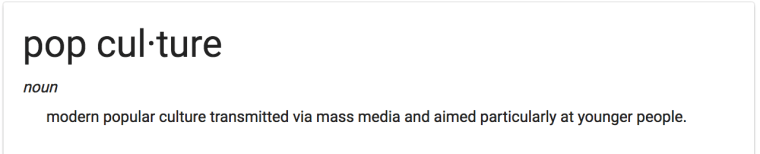
My initial response was rather sad. I wasn’t even sure what I was supposed to be referring to! So I did what everyone does.. I googled it.

500de98a14de7825f4ac4f1f8b4b46ab

And I got:

screen-shot-2017-03-02-at-8-33-50-pm

Now armed with a good definition, I can be part of conversation. While I may not personally be conversant in the current elements of “modern popular culture that is transmitted via mass media and aimed particularly at younger people, ” I do live and work with younger people every day. More than that, I talk with younger people.

So here is what I have to say about using pop culture to reach students. Yep, I know a lot of people who are really good at that. I’m not one of them. But unlike other areas where I have lots of teacher and mom guilt, this is NOT one of those areas.

  • I don’t watch movies.
  • I watch very little television. (Big Bang Theory and Fixer Upper)
  • I read a lot, but only occasionally books that young adults read.
  • I listen to music, but again, not music that teenagers listen to.. unless they listen to broadway show tunes!
  • I facebook, instagram, use twitter occasionally and have but don’t use snapchat. But my student’s are not my friends or contacts on these social media platforms. And they shouldn’t be. Boundaries are necessary.

And you know what? I am very happy living in the land of the uncool and “out of touch.” My students are desperate for real conversations and meaningful relationships. My lack of understanding of pop culture doesn’t hinder our bond. My students don’t love me or hate me because of my relating to them about a movie or song. They love me or hate me as a direct result of my  words, actions and daily response to their real needs be it educational or emotional. I know for a fact that for some of my students, I am the only adult that listens to them. I am the only adult that talks WITH them. I am the only adult that speaks wisdom into their lives.

So, no. I’m not a cool teacher. But that’s okay. I remember having a few teachers as a teenager that were just cool. They had a beat on pop culture and could authentically talk to us and with us about the things we enjoyed. But I didn’t learn more about the subject matter because of their ability to engage with students about the latest movie. I learned the subject matter when it was taught well.

On the flip side, I also had teachers that were the very definition of uncool. My chemistry and physics teacher didn’t watch television and could not relate to students at all in terms of pop culture. But he was incredible. He knew me and what I was capable of. He pushed me to work harder and do more. He was the first math/science teacher that made me see that I was smart and could do the work.  He new his role of mentor could not be replaced and valued his work too much to focus on things that were fleeting.

In the end, I have to say that yes, there are times when I’d like to be the cool teacher or cool mom. But I’m not and if I were to suddenly use the slang that is used by students, start snapchating and talking in class about the current trends, it wouldn’t be authentic and my students (and children) would see right through the effort. So instead of trying to figure out how to fit in, I don’t. I don’t need to be. That’s not my role.
i-roll-authentic_o_580696

7 reasons why I love working in a public school

THE LISTICLE – #EDUBLOGSCLUB PROMPT 7
I didn’t even know what a “listicle” was when I got this week’s #edublogsclub prompt! Thankfully, they had a wiki article about them… basically its a short form of writing for the internet that uses lists.
Well, I am all in on this one. I LOVE lists!!
So here you go…

7reasons

7 reasons why I love working in a public school

  1. You are challenged every single day to work to improve the lives of all people with no regard to race, color, creed, mental ability, disability or social status.
  2. You are challenged to do more with less resources than you thought possible. (Sure, we would all love more resources, and we deserve more resources, but being able to create magic in the lives of our students with sometimes nothing is pretty amazing.)
  3. You are given the opportunity to love thousands of students in the course of your career. As a high school teacher closing in on 20 years of teaching, I’ve already taught, mentored, and can tell you personal stories about more than 3000 students.
  4. You are given the opportunity to hone your craft, adapt your teaching style and become a better mentor with every new crop of students.
  5. You are offered a chance to learn from the past and start fresh every new academic year. Yesterday’s problems and last year’s power struggle don’t have to impact tomorrow’s promise.
  6. You are offered a chance to learn new curriculum  and teach new subjects. Just because you started off your career as a reading teacher doesn’t mean that you have to finish your career as one. Trust me. I hold 8 different certifications and have taught over 20 different subjects!
  7. You are NEEDED! You are IMPORTANT! You are VALUED! The world may say otherwise, politicians may make your life harder and give you more hoops to jump through, but at the end of the day, society needs you, children depend on you, and YOU MAKE A DIFFERENCE!

In this time of educational uncertainty where every time I walk by a news source and am horrified at the state of our political system, I am reminded that at the end of the day, the education system and public schools are filling a basic need in the lives of millions of students. This need will not go away no matter what politicians do to the system. So instead of wallowing in the uncertainty, I am choosing to celebrate in the daily successes my students.

May we all in public education fill our news feeds with celebrations, successes and the triumphs of teaching a truly diverse and incredible group of public school students.


A deeper approach for better results

In January, with the start of the spring semester, I deepened my approach to teaching basic drawing skills to my art 1 students. While they were not necessarily thrilled with this decision, they quickly saw the benefits to adding the “Drawing on the Right Side of the Brain” techniques. It’s something that I have wanted to do for years, but trying to fit in such a hands on approach during the middle of contest season just never seemed to work. But this year, I decided that even though I couldn’t do all of the steps, I could at least do the basic introductory steps.

I have Betty Edwards workbook and have adapted her lessons to fit a high school classroom. Her workbook is phenomenal and I wish we had time to do the entire book. (If I had just a drawing class, this is absolutely what we would do!) I take her concepts and teach basically the first five or six lessons.
9781585421954

What is truly amazing is that these techniques, because they are visual lessons and not language dependent work for ALL students of ALL abilities. Given that my classes are made of mixed abilities from the valedictorian to the non-speaking life skills student, I truly value lessons that work for all students!

Over a couple of weeks, my students learned to see every day objects with new eyes. They learned how to use a simple transparency to transform their drawings. They learned how to break large concepts into small manageable segments. And oh man, it has changed the way my students view drawing!

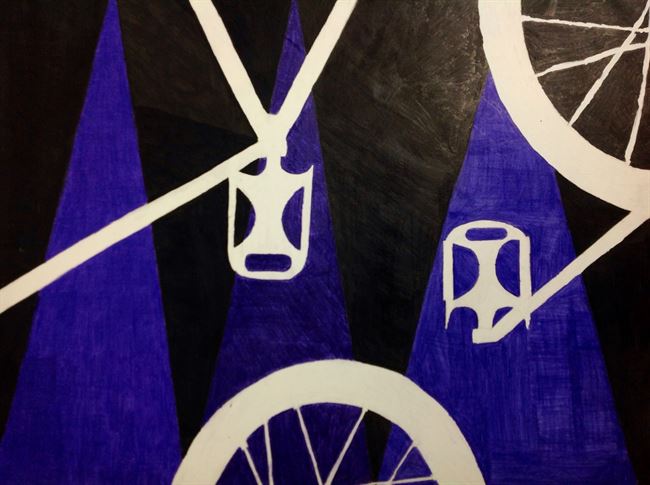
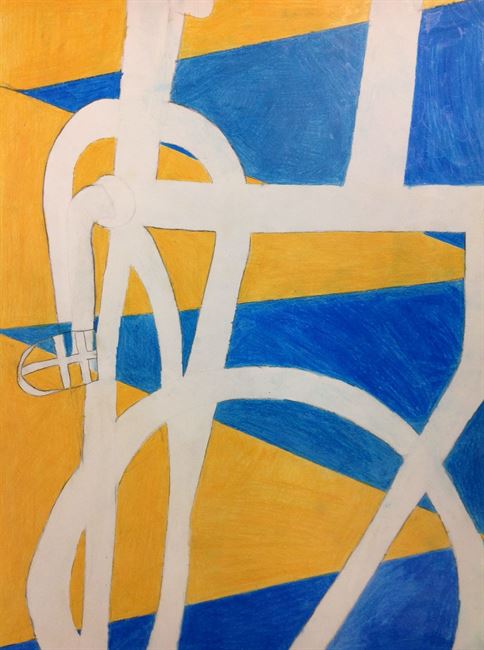
After working through basic lessons, I took a couple of my daughter’s old bicycles up to the school and set them up for the students to draw. Students then took their drawings and enlarged them onto a 18×24 piece of paper that they then had to create a positive and negative pattern on. This felt like it took forever.

But the projects are fantastic! This is the first drawing project where almost every one of my students were not only successful, but created a quality piece of art! Students that are frequent fliers in detention worked bell to bell for weeks on this piece! How I wish I could show you all 100 pieces and tell you the story of every student while you looked at their piece.

But I can’t. So I’ll show you a few really cool pieces.

So anyway, I just had to share this success story. It’s so gratifying when going that extra mile and doing that extra hard thing is rewarded. That’s a rare thing in education!

And the next time I want to set aside the lesson plans and take a few extra days to teach in a more meaningful way, I am going to remember this feeling and these results and give myself the grace to go rogue.

This slideshow requires JavaScript.

CHALLENGING SITUATIONS

CHALLENGING SITUATIONS – #EDUBLOGSCLUB PROMPT 6

This week’s #edublogsclub is about challenging situations in education. Wow. Well, as a veteran educator, I feel like I know a thing about challenges in education just from surviving this long in this profession.

I’ve been pondering education and what I consider to be the overarching challenges no matter the age or subject and these are my top 3 challenges. I found pictures from my phone to illustrate!

The greatest challenge in my opinion is knowing how much pressure to apply on students and teachers. Too little pressure and the results are lack luster. Too much pressure and the teacher and/or student folds under the weight of expectations.

I love the idea of clay on a pottery wheel as a metaphor for education. When we throw clay on a pottery wheel, it is important that the clay be wedged, have the right moisture content and be placed on the correct spot on the wheel. If any of these aren’t done correctly, the piece that is going to be thrown won’t look/work right. Further, as the wheel spins, only so much pressure can be applied to the clay at a time. Too much pressure from one side without balancing the clay in other hand will force the clay to move across the batten (base) and eventually the clay will spin off the wheel!

img_7935-2
Learning to use the right amount of pressure.

Such can be said for education! The expectations on students and teachers are spinning out of control. The increased pressure to perform better with fewer resources has caused schools to spin faster and faster and teachers and students are being slung from side to side and are holding on by a raveling thread.

Next, those that legislate education seem to forget that educators can only do so much without the proper tools. I thought this picture from my phone was perfect. A few weeks ago I need to get a cork out of a bottle, but I didn’t have a cork opener. I did a little google searching and found a you tube video that showed how to use a key to get the cork out of a bottle. I figured why not, worse case is that I ruin the cork and I can’t drink the glass of wine. So I used my house key, followed the instructions and amazingly it worked! The cork, while it didn’t look great, survived and I was able to use it to close the bottle back up.

img_9781
Not having the right tool.

This is totally the way education works! In order to get to the “prize” of good test results or  an appropriate level on the state’s accountability scale, educators are expected to figure out how to reach students without ruining the love of learning in the process and without the correct tools! The concept of “making do” is such a part of education that it’s not discussed, it just is.

And finally, my third challenge to education is that the curriculum that needs to be taught is not and can not be the priority because we are teaching children and these children deserve more than just robots that spout platitudes and absolutes.

img_9851
Understanding that what you want and need to teach is wrapped up in knots and is buried under the weight of a student’s life, the educator’s expectations and the government’s policies.

This picture from my phone is of a large mess of yarn and string tangled together. This is the very definition of teaching! Every piece of yarn represents one of my students and the pieces of yarn are tangled, knotted and completely and utterly dependent on each other to be untangled and to be given lives of their own. Sure I can pretend that the mess doesn’t exist and I can try to pull out just one piece of yarn at a time, but the reality is that in order to teach one student, I have to figure out how to teach the masses, the messes and the tangled jumble of lives. It is only when we have the yarn ball at least somewhat unraveled that we can begin to move onto teaching and learning curriculum.

So there you have it. This is where I see the challenges in education.


The Value of Pictures

This week’s #EdublogsClub prompt was to add photos to posts. Well, I’ve got that one down. I am constantly taking pictures and videos. My life is well documented. In fact, I have to say that I am rather proud of the fact timg_9832hat while there are 7,802 pictures in my phone, many of those pictures include fun family moments, cool projects that my students are working on and simple everyday selfies. And these photos haven’t been taken and left to die in my phone. They live again on instagram, twitter, this blog, Artsonia and facebook!

As an educator, I have learned the value of a picture taken of a student at work in my environment. A picture can express hope, frustration, encouragement, success, failure and so much more. I use pictures to show what my students are working on, what they are struggling through and eventually their successes. It keeps students accountable as I post updates on my high school art facebook page regularly and no student wants basically the same photo uploaded day after day!

Further, parents really enjoy looking into the world that their children spend so much time in. There are no secrets in my classroom and I really work hard to get authentic moments. Yes, I often end up telling kids to move their phones out of the shot.. not because I want to hide the fact that they are listening to music from their phones, but their phones are not the story of the picture and I’m afraid some naysayers about education and teens would see the phones and not see the kids hard at work!

Below are pictures taken on Tuesday from my classroom during one of my art 2 classes. It only takes a couple of minutes to take pictures and post to my school facebook page, but the goodwill from student’s families and friends is incredible!


So there you have it. I truly love taking photos of students at work and of their finished projects. It clutters my phone and overwhelms my storage space at times, but it is worth it. Besides having photo evidence of what is happening in my world, it also is a really important level of transparency in this day and age. While I don’t take pictures of every student everyday, the body of photos show the life, camaraderie and work ethic of my students and the once hidden high school art room is captured, shared and enjoyed by students, parents and the community as a whole.

The parallels of long distance running and public education

I’m writing this from the comfort of my recliner. My sore and blistered feet are propped up and I’m eating all the carbs in sight. Why? I ran a 1/2 marathon yesterday, so today I feel entitled to calories and rest.

I’m not a new runner and the 1/2 marathon (13.1 miles) distance is one that I typically enjoy and am trained to complete. Yesterday’s race I made “rookie” type mistake and wore shoes that I knew going in I shouldn’t wear, but I did anyway. I paid for it.

By mile 3 my feet hurt. By mile 6 every left step was uncomfortable. By mile 11 the hot spots on the side of my right foot were killing me. But I kept going. I considered stopping and checking on my left foot, but I didn’t want to see the wound that I knew was there. So I just endured it and finished the race.

And while contemplating my stupid shoe issue, I came to realization that much like the problems with my shoes, so are the problems in education.

How? Well here are my parallels.

  1. These shoes are not a new shoe for me. I’ve worn this brand for years. But this pair is newer and they have never felt right. While the brand and the style didn’t change, something about the way they were made was changed.

    Isn’t this the way of high stakes testing? We have been testing in public education for years and years. I’m not even saying that testing is bad. We need markers so that we know what learning is taking place. But the way the tests are made has changed. The purpose and the mindset has changed even though the official reasons for testing are still said to be to measure student success.

    And because the shoe still looks like the shoe we know, we expect to be able to wear it the same with the same result.. and we end up with a bloody toe. And the test while it has changed its name over the years, still is supposed to measure student success, so we and teach the students the way we know how, expecting the same results… and we end up with disenfranchised and unsuccessful students. 

  2.  The shoes never fit right, but I wore them anyway.

    From the first time I wore the shoes, the tops of my toes rubbed in them. For short runs, my toes would be a little pink when I finished running, but it wasn’t too bad. For longer runs, I’d make sure that I wore thin socks.  I knew there were issues. But I continued to wear them. My older, comfortable shoes were past their mile markers and not suited to long runs anymore. And of course, I had just gotten these shoes. They were clean and pretty! They just had to get better!

    And so goes education. After almost 20 years in public education, I can say honestly that some of the things that we do are just plain stupid. The newest and best things for engagement, to boost test scores, to prevent drop out.. and on and on.. some of these things do work. (This post isn’t about those things…. ) And some of them never fit right, they rub students and teachers the wrong way, have continued issues and are just bad. But we do them anyway, because it is the new thing..it’s shiny and clean and pretty.. and surely, once we get used to it, it will get better! 

  3. I knew that the problem existed, but I ignored it.

    For months I wore my “pink ghosts” knowing that they didn’t fit right. But I ignored the problem hoping that eventually the issues would work themselves out. Every time I put them on, I knew the possible blisters. I would rationalize the issues and go on with my run.  My toes would hurt after a few miles, but oh well. I’d tell myself to get out that other pair of shoes from my closet and try a different pair. Good intentions and really pretty easy to take care of. But after my workout, I’d be in a hurry and quickly be off to work and not think about the shoe issue until I was about mile 3 into a run. I know, it doesn’t make sense.. but not much makes sense a 4:30am! 🙂

    And the same goes for education! Oh my does it! We know that problems exist and we even know how to fix many of them. But we act as if we ignore the problems that they will eventually either get fixed, graduate or go work someplace else! This mindset helps no one, nor does it make sense.

Running and public education are my passions.

As I strive to be a better runner, I have to be willing to stop and make necessary changes… often ones that only can be seen after the first 6 miles… including trying a new brand or style of shoes.

As I strive to be a better advocate for public education, I have to be willing to stop and make necessary changes.. often ones that can only be seen from inside the school building. For now, I focus on my classroom… but one day in the not so distant future a campus? I can hope. Until then, I will remember that this is a marathon.